
Home · Workbench · Self-op studio: a whole show run by one person
Self-op studio: a whole show run by one person
One person plans the show, hosts it and broadcasts live. Switching is done by voice. A key or foot pedal works at any time, but neither is needed.
A TV show usually takes half a dozen people: editorial, director, switcher operator, graphics, someone on the teleprompter and the host.
For a local station, an association or a company with its own format, that is hardly affordable. In the self-op studio, one person does it. The editorial team plans in the browser, and in the studio, the host stands alone in front of the camera. In television, this is called self-op, short for self-operated.
During the show, nobody has to press a key. Speech recognition follows the text word by word. When a host segment is finished, the autopilot starts the next clip. When the clip is over, the next host segment is on the teleprompter. Lower thirds, the captions with name and title, appear at the point in the text where they belong. An interview with a guest ends when the host says the agreed closing line, such as “Thank you for talking with us.” The key and the foot pedal still work at any time, for example if she wants to cut something short on the spot.
The AI prepares the texts and the rundown before the show. People decide what goes on air.
- Rundown
- Scripts
- Teleprompter
- Guests
- Broadcast
The team plans the rundown in the browser, everyone at the same time. MetroNews, 37 minutes
The AI newsroom writes the host segments, and the show assistant cuts them to length. cut by 0:40
The teleprompter scrolls the text as the host speaks. When the segment is finished, the next clip starts without her pressing a key. segment done, clip running
Guests join via a link, and the switcher cuts to the person who is speaking. guest via link
The show streams live on your website, without a third-party platform. live from 6 p.m.
- Switches to the next clip by voice
- The teleprompter scrolls at the pace of the voice
- The show assistant suggests cuts to fit the airtime
Speech recognition does the switching, so nobody has to press a key. Anyone who wants to can still use a key or foot pedal. That way, a small organization can broadcast its own TV without a studio crew.
Comms & media
In use
Screens from the real software
The screens show the German interface. Names and content in them are examples. Click an image to enlarge it.
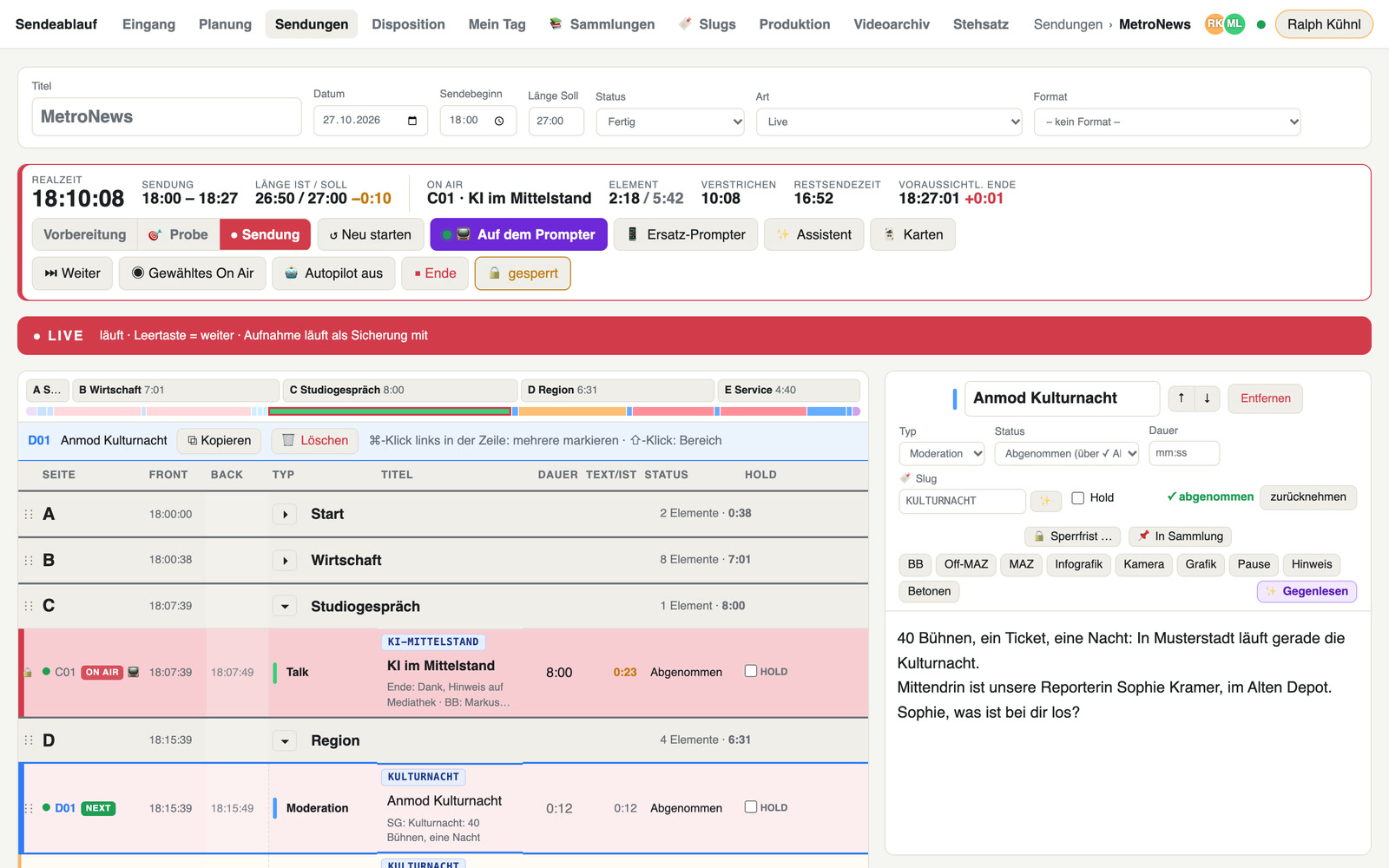
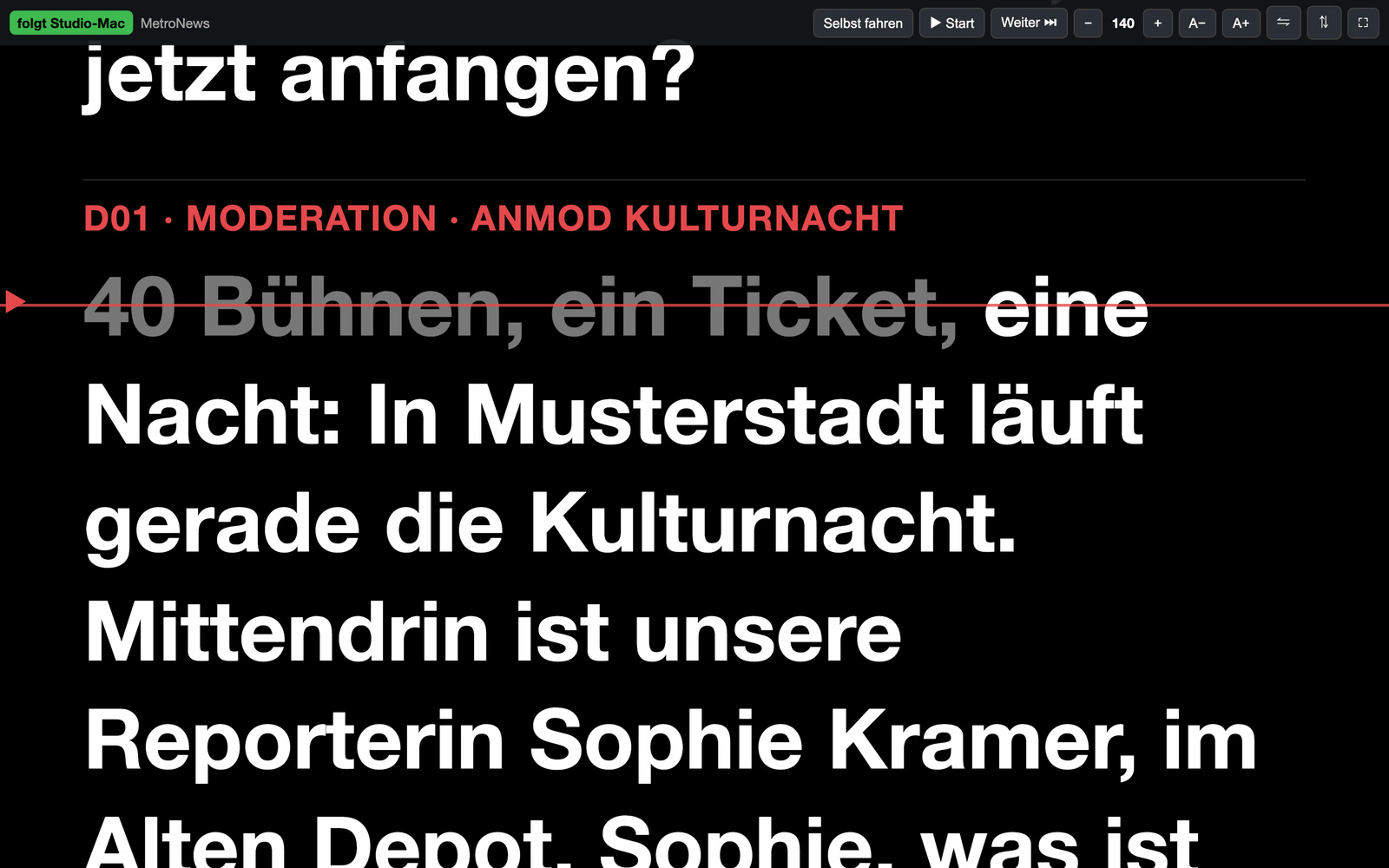
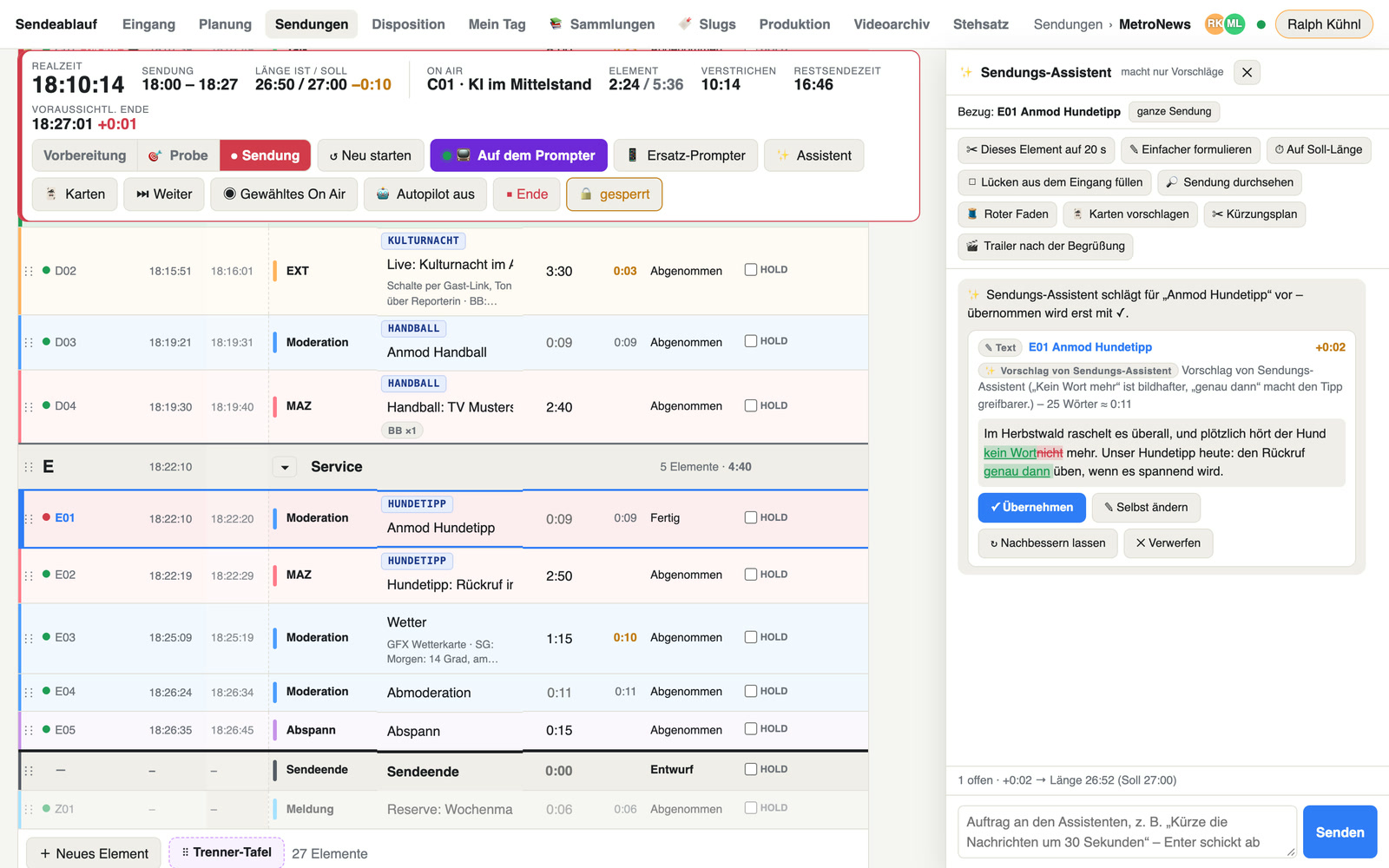
The demo show from this studio
37 minutes of MetroNews, produced in the self-op studio: hosting, segments from the AI editing suite and a guest joining remotely. Ralph Kühnl hosts alone, without a studio crew and without post-production. The autopilot did all the switching for the entire show: in those 37 minutes, it never needed a key or the foot pedal. MetroNews is a made-up name, and the show is in German.
When you press play, the video loads from YouTube (youtube-nocookie.com). Watch on YouTube
A 6 p.m. magazine show, run by one person
An example of a broadcast day: in the morning, the editor goes through the day’s news in the inbox, which the system has collected from press offices, public authorities and email and sorted by relevance. She plans a 30-minute magazine show with three pieces and a guest joining remotely. The show assistant suggests a rundown and calculates the length, and then the host segments are on the teleprompter. At 6 p.m., she stands alone in the studio. The teleprompter scrolls the text as she speaks. Once she has read the intro, the first piece starts, and after the piece, the next host segment is ready. The guest joins from his office via a link, and the picture switches to whoever is speaking. With the agreed closing line, she says goodbye to him, and the show continues. She didn’t press a single key in those 30 minutes. The show streams live on her own website and is recorded in broadcast quality at the same time.
Prompter, switcher, guests and rundown in one studio
Teleprompter and autopilot with speech recognition
The prompter recognizes what is being said and scrolls the text along. It stops during pauses and jumps back when something is repeated. When a host segment is finished, the autopilot switches to the next clip. The key and the foot pedal work at any time, and if speech recognition fails, they take over. Speech recognition runs on the device itself, without an internet connection.
The broadcast picture from one program
Camera with a backdrop graphic behind the host, plus headline, clips and lower thirds at their place in the text, a virtual studio, either in front of a green screen or without one, in which case an AI cuts out the host. Recording is in broadcast quality.
Guests via link
A browser is all they need. The switcher automatically shows whoever is speaking, and each guest is recorded separately.
Live streaming
To a video platform or to your own website, there without cookies and without third-party services.
Rundown as a team
Your whole team can write on one show at the same time. A show clock shows planned and actual time, a traffic light shows the approval status, and a backup piece is ready in case something is missing.
One inbox for all news
Press releases, official warnings and news from email arrive in one place. The AI sorts them by how important they are for your broadcast area.
Show assistant
The assistant drafts the whole show, cuts it to the planned length and plans what happens if the show runs over. Everything comes as a suggestion. AI text is marked until someone approves it.
Archive with full-text search
Every show can be searched by script and spoken word, with rights and embargo periods for each video.
Your own shows for local stations, associations, companies and universities
Local and regional TV stations that fill a show every day with a small staff. Associations and chambers that want to reach their members with their own video format. Companies with internal TV for staff and locations. Universities and education providers that want to record lectures and panel discussions in TV quality without employing a studio crew.
Texts and pieces come from the newsroom and the editing suite
The AI newsroom writes the host scripts to fit the speaking pace, and pieces and intros come from the AI editing suite. It would also be possible to embed the live stream in a live blog in Tickerwerk and to suggest short clips for social media from every show automatically.
A tool like this, built for your workflow.
Talk about your show format